

Key Points To Remember
- For pharmacists the PTE test incorporates advanced AI-based scoring to ensure that the evaluation is both accurate and impartial.
- The minimum score is 65 which is required for Australia in each skill area.
- The Speaking and Dictation tasks are the ones for which the highest score weight is given.
- Compared to the IELTS or PTE Academic for Australia is a lot quicker in delivering the results.
- Focus should be on fluency, accuracy, structure, and managing the time.
- Consistent mock test results in enhancement of confidence, speed, and overall performance.
- Integrated tasks involve different skills simultaneously.
- Practising strategically is of great importance rather than just doing random repetitions.
Are you interested in working as a pharmacist abroad? If so then an English proficiency test is essential for pharmacy graduates from abroad who want to work in English-speaking countries. It is applicable for Australia or New Zealand, the UK or Canada and Ireland are some of the countries that need applicants to show that they have a good level of English. Before they can be registered as a professional pharmacist and practice. The PTE exam for pharmacists 2025 is one of the most popular and reliable tests chosen by candidates. This is mainly because the test is evaluated by fair and advanced technology. The results are released quickly and the exam is recognised globally.
The Pearson Test of English Academic is most commonly referred to as PTE Academic. It is an instrument for measuring language skills in the most authentic way through communication in English. These four modes are Speaking, Listening or Reading and Writing. Unlike traditional tests PTE is an entirely computer-based test and the scoring is also done by AI. Thus there is no human intervention or which means that there is no prejudice and the marking is done in a very consistent way.
This guide is geared towards students and goes into a lot of detail while still being very easy to grasp. The layout of the exam or how the score is calculated and the way you prepare and the differences between PTE and IELTS. Additionally, it offers useful PTE writing suggestions or effective speaking techniques and commas that are often overlooked. If your goal is AHPRA registration or skilled migration or reading this post will make it clear to you how to get the PTE band score that you want with certainty and without any doubts.
Exam Pattern Overview
The PTE Academic is a test done entirely on a computer and it takes about 2 hours in total. The test is aimed at gauging the use of English through integration, meaning that a single task can be the result for more than one section of the score. This scoring system reflects the integration of the language skills. Therefore makes it very important to consider every task as valuable even if tiny errors occur. They can still influence the overall score.
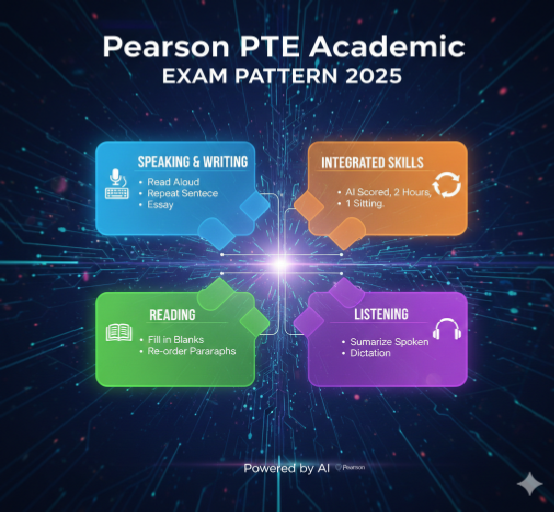
Structure of PTE Academic
| Section | Duration | Main Tasks | Skills Evaluated |
|---|---|---|---|
| Speaking & Writing | 54–67 mins | Read Aloud, Repeat Sentence, Describe Image, Summarise Written Text, Essay | Speaking, Writing, Reading |
| Reading | 29–30 mins | Multiple Choice, Re-order Paragraphs, Fill in the Blanks | Reading, Writing |
| Listening | 30–43 mins | Summarise Spoken Text, Write from Dictation, Multiple Choice | Listening, Writing, Reading |
Key Points for Pharmacists
The Speaking and Writing parts of PTE are the ones that take the most time and are the main factors in the overall score. Spoken tasks like Read Aloud and Repeat Sentence mainly influence both Speaking and Reading scores. Write from Dictation in the Listening section or in general. It is the major contributor to Writing and Listening scores. As PTE has integrated scoring, a single task performance will be your multiple skill areas' proficiency level.
The format of the test is sleek and easy to use, however, it does demand effective time management. Every task is allotted a certain amount of time and if a response is sent, it cannot be altered. Hence, it is necessary to have a well-organised preparation plan and to rehearse in a time-constrained manner.
Minimum Score Requirements
International candidates aiming to register as a pharmacist in Australia need to satisfy the English language requirements set by AHPRA (Australian Health Practitioner Regulation Agency). These requirements are put in place to ensure that pharmacists can communicate safely and effectively with patients and other healthcare professionals.
PTE Academic for Australia – Pharmacists
| Test | Required Score |
|---|---|
| PTE Academic | Overall 65, no band below 65 |
| IELTS Academic | Overall 7.0, no band below 7.0 |
| OET | B in all components |
Important Notes
In a single sitting, candidates have to obtain the necessary score. Typically, the merging of scores from several test trials is not allowed for AHPRA registration. PTE scores are considered valid for a maximum of two years from the date of the test. Additionally, better scores can also lead to a higher number of migration points under skilled visa programs. There is a need to frequently verify the up-to-date instructions given by AHPRA since the requirements may change occasionally.
PTE vs IELTS: Which is Better for Pharmacists?
Before choosing between PTE or IELTS will rely on one's preference, learning style and level of comfort when doing a computer-based test. Many pharmacists, however, say that PTE is easier for them.
Why Pharmacists Prefer PTE
The PTE ensures fair and impartial marking to provide reliable scoring results as the answers are assessed by an AI system. To a great extent, candidates find it easier to express themselves to a machine than to a human examiner as it helps them calm down. The quick result delivery time is turning PTE into a perfect test for people who have to submit their documents within a short period. Furthermore, due to the well-organised format of the test or students are able to raise their test scores by following certain practice methods.
| Feature | PTE Academic | IELTS Academic |
|---|---|---|
| Test Type | Fully computer-based | Paper or computer |
| Speaking | AI-recorded | Face-to-face interview |
| Results | 1–2 days | 3–13 days |
| Scoring | AI-based | Human + examiner |
| Preferred by Pharmacists | High | Moderate |
Practice Strategy for High Scores
If pharmacists are willing to get a band score of at least 65 in PTE they are required to follow a preparation plan that is not only focused but also smart. Those who practice randomly without comprehending how the scoring works will not be able to make progress quickly. So, it is better to focus on those tasks that have the greatest impact on the final score.
High Priority Tasks
| Task | Score Impact | Focus Area |
|---|---|---|
| Repeat Sentence | Listening & Speaking | Memory and fluency |
| Read Aloud | Reading & Speaking | Clear pronunciation |
| Write from Dictation | Listening & Writing | Spelling accuracy |
| Fill in the Blanks | Reading & Writing | Grammar and vocabulary |
By practising these tasks daily, you can greatly improve your performance in various sections. Make sure to time your responses, listen attentively, and concentrate on correct pronunciation and spelling.
PTE Writing Tips for Pharmacists
The writing component is a significant part of the PTE test and is the main factor that most of the time decides the success or failure of candidates.
Summarise Written Text
You are asked to compose a single sentence that captures the essence of the source in these assessments. In there the sentence has to comprise only the two or three most important concepts and must not exceed the specified number of words. You do not use several full stops and concentrate more on linking the ideas coherently by using simple connectors.
Essay Writing
The essay should have a clear outline and be logically planned. It is advised to use a simple four-paragraph plan: introductory paragraph or two body paragraphs and a final paragraph. Try to keep your words between 250 and 280. Speak straightforwardly or use proper grammar and give appropriate examples. Don't use memorized content that sounds unnatural or like it is not related to the topic.
Nice writing is a result of clear thinking or logical flow and being accurate. Daily practice together with feedback is the way to develop both consistency and confidence.
Speaking Strategy for Better Scores
The fluency is what counts the most in an AI evaluation of speaking tasks. The system gives higher scores to smooth and continuous speech rather than to fast speech or a speech with complex vocabulary.
Essential speaking hints:
- Keep up a regular pace
- Try not to hesitate or pause for too long
- Don't start over with a sentence
- Concentrate on being clear when you speak
- Speak using basic language and follow a logical structure
In this exam the one of the important ways to pinpoint mispronunciations and instances of hesitation is to tape practice sessions and then listen to them. It can also control breathing and confidence can make the test go smoothly.
Reading and Listening Strategy
Reading
For getting good score the reading tasks are an evaluation of the learner's comprehension or grammar and vocabulary. All of the activities like Fill in the Blanks and Re-order Paragraphs help to enhance one's knowledge of sentence structure and grasp of the context. In addition reading newspapers and academic articles every day will have a positive effect on the development of these skills too.
Listening
Listening measures your understanding of spoken English. The one of the most significant activities is writing from dictation and it should be practised consistently. You need to make sure to focus on the correct spelling or punctuation and sentence structure. The whole podcasts and academic lectures are great ways to get used to the pronunciation and sentence patterns.
Common Mistakes to Avoid
Hundreds of candidates fail to keep their scores because of errors which could have been easily prevented. These errors are:
- Not regulating your speaking speed properly
- Repeating memorized answer structures without control
- Committing spelling errors in a dictation task
- Not following punctuation rules
- Not finishing answers
- Overthinking and not having enough time
Once candidates recognize these errors, they are able to fix them at an early stage and hence their final band scores will be raised effectively.
Sample Daily Study Timetable for Pharmacists
Such a schedule is meant for pharmacists to work and still be able to spare just 1 or 2 hours daily from their time.
From Monday to Friday:
- 20 minutes: Reading Aloud + Sentence Repetition
- 30 minutes: Summarize Written Text or Write an Essay
- 20 minutes: Writing from Dictation
- 15 minutes: Error and Feedback Review
Saturday:
- Complete mock test (2 hours)
- 30 minutes in-depth analysis
Sunday:
- Light revision + weak area practice
- Listening practice with PTE audio clips
Small daily attempts, which are kept consistent, result in a solid long-term progress.
Elite Expertise PTE Preparation Course
Best couching Elite Expertise has come up with a well-organized PTE preparation program that is specifically intended for pharmacists and healthcare professionals. The course is equipped with one-to-one coaching, AI-driven mock tests, and in-depth performance analysis. Students get support and direction from a mentor who is specially trained to help them not only maintain their progress but also work on their weak areas.
The course is guided by Mrs. Winnie Rose Jacob, a certified PTE expert trainer.
With the help of the program, students receive instantaneous feedback or detailed study plans and frequent assessments that mimic the actual exam environment. This encouraging method instills self-assurance and leads students to attain their desired scores in a shorter time and with less effort.

Conclusion
An international pharmacist looking for professional registration and career opportunities abroad can consider the 2025 PTE exam for pharmacists as a trustworthy and convenient way to achieve their goals. Once the candidates comprehend the test format or the lowest score requirements and the preparation tactics. They will be able to take the exam with a great deal of confidence.
It becomes real to achieve a score of 65 or above in each band by concentrating on high-scoring tasks, keeping the fluency, practising regularly and not making common mistakes. Preparation that is well structured and planned intelligently leads to success.