

The Overseas Pharmacists Readiness Assessment (OPRA) exam is crucial for overseas-trained pharmacists aspiring to become registered pharmacists in Australia. Recently, several changes have happened to this examination, including a name change from Knowledge Assessment of Pharmaceutical Sciences (KAPS) to OPRA. It is designed to assess the clinical and practical readiness of international pharmacy graduates. The OPRA exam is conducted by the Australian Pharmacy Council (APC). Recently, APC had brought some modifications to the syllabus and exam, which reflects the evolving healthcare sector of Australia.
This blog post contains the changes that highlight what's new in 2025 and provides guidance on how to prepare effectively. It also offers special insights into the expert-led coaching provided by Elite Expertise, trained by seasoned clinical pharmacists Mr. Arief Mohammad and Mrs. Harika Bheemavarapu.
Why was the OPRA Exam syllabus updated?
The practice as a pharmacist in Australia is continually adapting to new healthcare technologies, patient-centered care models, and intern professional collaboration. These changes demand that assessment tools like OPRA stay current & comprehensive. The 2025 OPRA syllabus update reflects:
- Increased emphasis on clinical scenarios and patient safety topics
- Integration of digital health and electronic prescription
- Expanded pharmacist role in chronic disease management and vaccinations
- Updated Australian healthcare guidance and protocols
What is the OPRA Exam syllabus?
The OPRA exam syllabus mainly consists of 5 major content areas
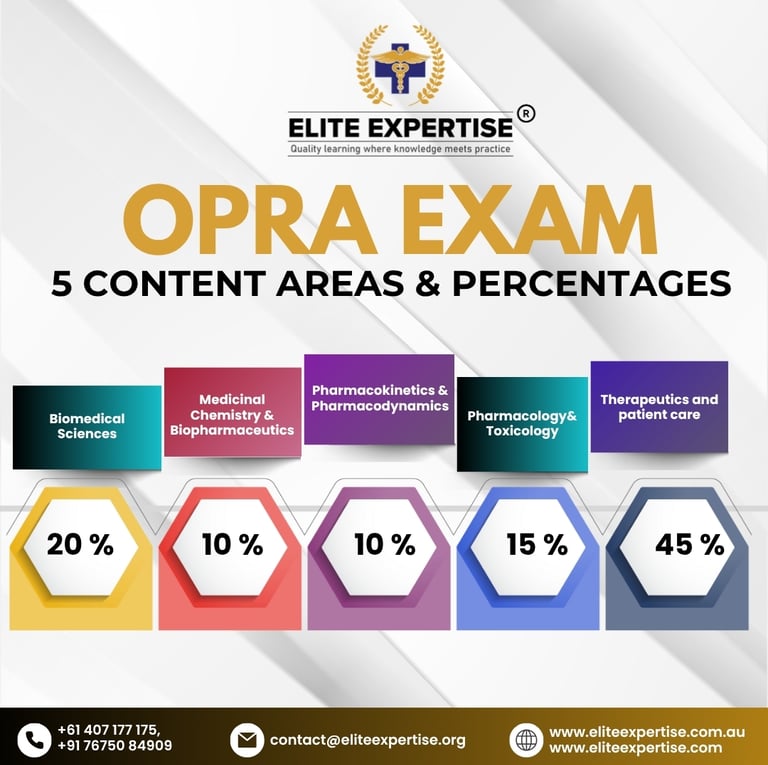
Detailed breakdown of the OPRA Exam syllabus (2025)
New topics introduced
1. Biomedical science
Assessed Content and Topics
| Topic Area | Description |
|---|---|
| Physiological Processes & Normal Function | Includes functions of all major body systems (CNS, digestive, cardiovascular, lymphatic, respiratory, urinary, endocrine, reproductive) and their integration; blood and body fluids. |
| Pathophysiology | Focus on how normal physiology is disrupted by genetic, environmental, chemical, physical, infectious or drug-induced causes leading to disease states. |
| Medical Microbiology | Study of infectious agents including bacteria, viruses, fungi, and parasites; mechanisms of pathogenesis and infection. |
| Immunology | Immune system function, innate and adaptive responses, disease defense, vaccines, and immunization strategies. |
| Disorders Affecting Bodily Fluids | Involves fluid and electrolyte imbalances, acid-base disorders, and various blood-related disorders. |
| Symptoms & Physiological Values | Includes recognition of signs and symptoms, diagnostic tests, and lab values for assessing normal vs abnormal conditions. |
2. Medicinal Chemistry & bio pharmaceutics
Assessed Content and Topics – Pharmaceutical Sciences
| Topic Area | Description |
|---|---|
| Physicochemical Properties of Drugs | Understanding properties relevant to ADME – absorption, distribution, metabolism, and excretion. |
| Formulations for Drug Delivery | Study of solids, solutions (aqueous/non-aqueous), suspensions, emulsions, and all related physical states used in drug dosage forms. |
| Drug and Chemical Stability | Includes degradation mechanisms (e.g., hydrolysis, oxidation), kinetics (zero/first order), and influence of pH and temperature. |
| Solubility | Explores factors influencing solubility and dissolution, including partitioning and thermodynamic principles. |
| Drug Formulation | Materials and formulation strategies for various administration routes: oral, parenteral, transdermal, nasal, pulmonary, ophthalmic, rectal, vaginal. |
| Pharmaceutical Microbiology | Focus on preservation techniques, use of antimicrobial agents, and sterilization processes in pharmaceutical products. |
3. Pharmacokinetics & pharmacodynamics
Assessed Content and Topics – Drug Metabolism & Pharmacokinetics
| Topic Area | Description |
|---|---|
| Drug Metabolism | Chemical and biochemical mechanisms of drug action, metabolism pathways, absorption, biotransformation, elimination, receptor theory, and molecular pharmacology. |
| Principles of Pharmacokinetics | Core concepts: bioavailability, bioequivalence, half-life, clearance, distribution, protein binding, and achieving steady state drug levels. |
| Factors Affecting Drug Impact | How disease states, physiological conditions, and diet influence ADME processes and pharmacological responses. |
| Evaluation of Pharmacokinetic Data | Interpretation of drug concentration vs time graphs, drug interactions, and pharmacokinetics of narrow therapeutic index drugs. |
| Clinical Use of Pharmacokinetics | Applying PK data for dose individualization, monitoring, adjusting therapy in renal/hepatic dysfunction, and calculating loading doses and time to steady state. |
4. Pharmacology & toxicology
Assessed Content and Topics – Pharmacodynamics & Drug Safety
| Topic Area | Description |
|---|---|
| Impact of Drugs on the Body | Effects on organs and systems, dose-response curves, roles of agonists, antagonists, enzyme modulators, and clinical implications of genetic polymorphism. |
| Receptor Theory | Interaction of drugs with receptors, types of agonists and antagonists, dose-response relationships, desensitization, and supersensitivity. |
| Mechanisms of Drug Action | Mechanisms by which drug classes act on body systems and disease states, including CNS, cardiovascular, oncology, and metabolic pharmacology. |
| Adverse Drug Reactions | Common and serious side effects, classification of ADRs, underlying mechanisms, and clinical management. |
| Drug Interactions | Mechanisms and types of drug-drug interactions, receptor and enzyme interactions, hydrophilic/hydrophobic effects, and binding characteristics. |
| Drug Toxicity & Treatment | Recognition and management of toxicity, including signs, symptoms, overdose treatment, and use of antidotes. |
| Factors Modifying Drug Effects | Influences on drug pharmacology/toxicity: physiological (age, sex, genetics, pregnancy), pathological (renal/hepatic dysfunction), and pharmacological factors. |
5. Therapeutics & patient care
Assessed Content and Topics – Pharmacodynamics & Drug Safety
| Topic Area | Description |
|---|---|
| Screening | Includes calculation and interpretation of BMI and creatinine clearance to assess patient health and renal function. |
| Dose Calculations | Drug dosing based on weight, age, surface area, and pharmacokinetics. Includes dilution, reconstitution, flow rates, isotonicity, and electrolyte solutions. |
| Primary Health Care | Choosing appropriate treatments for common illnesses and identifying when non-drug interventions are more suitable. |
| Special Populations | Safe medicine use in children, elderly, pregnant, and breastfeeding individuals with focus on precautions and contraindications. |
| Safe Medicine Use | Ongoing assessment and promotion of adherence to therapy, including evaluation and adjustment of treatments when necessary. |
| Harm Minimisation | Understanding how to prevent misuse, abuse, and diversion of medicines in patients and communities. |
| Health Promotion & Disease Prevention | Strategies to maintain wellness, encourage healthy lifestyles, and apply non-pharmacological interventions. |
| Confidentiality | Professional responsibility regarding patient privacy, secure record handling, and ethical information sharing. |
What are the changes in the exam format?
The format of the OPRA exam in 2025 has been streamlined for better assessment of real-world skills:
- Multiple-choice questions: single paper with 120 MCQ-based questions, which is conducted in a computer-based setup at designated APC-approved test centers
- Scenario-based assessment: Case study-type questions that emphasize clinical aspects and patient care
- Exam duration: 2.5 hours long
- Scoring: According to Rasch's methodology, it is more transparent with criteria focusing on safety, accuracy, and professionalism rather than memorized knowledge
What are the OPRA exam preparation tips for success?
Here are the OPRA exam preparation tips that help you succeed
- Focus on clinical reasoning-practice questions on the case study
- Stay updated with the Australian guidelines and PBS schedules
- Join a professional coaching program to ensure strategic preparation
- Simulate the exam environment for practicing mocks with time limits
- Master the communications skills for patient counseling & ethical decision-making
- Understand the Australian healthcare system and the practices followed in the pharmacies